
The ads recruiting plaintiffs for privacy claims used to come from law firms. Increasingly they come from a new kind of company: a venture-backed claims marketplace that finds consumers, qualifies them, and hands them to partner law firms in bulk.
The two ads below are from one of those companies, and they ask about one brand: Carhartt, the workwear maker.
The ads
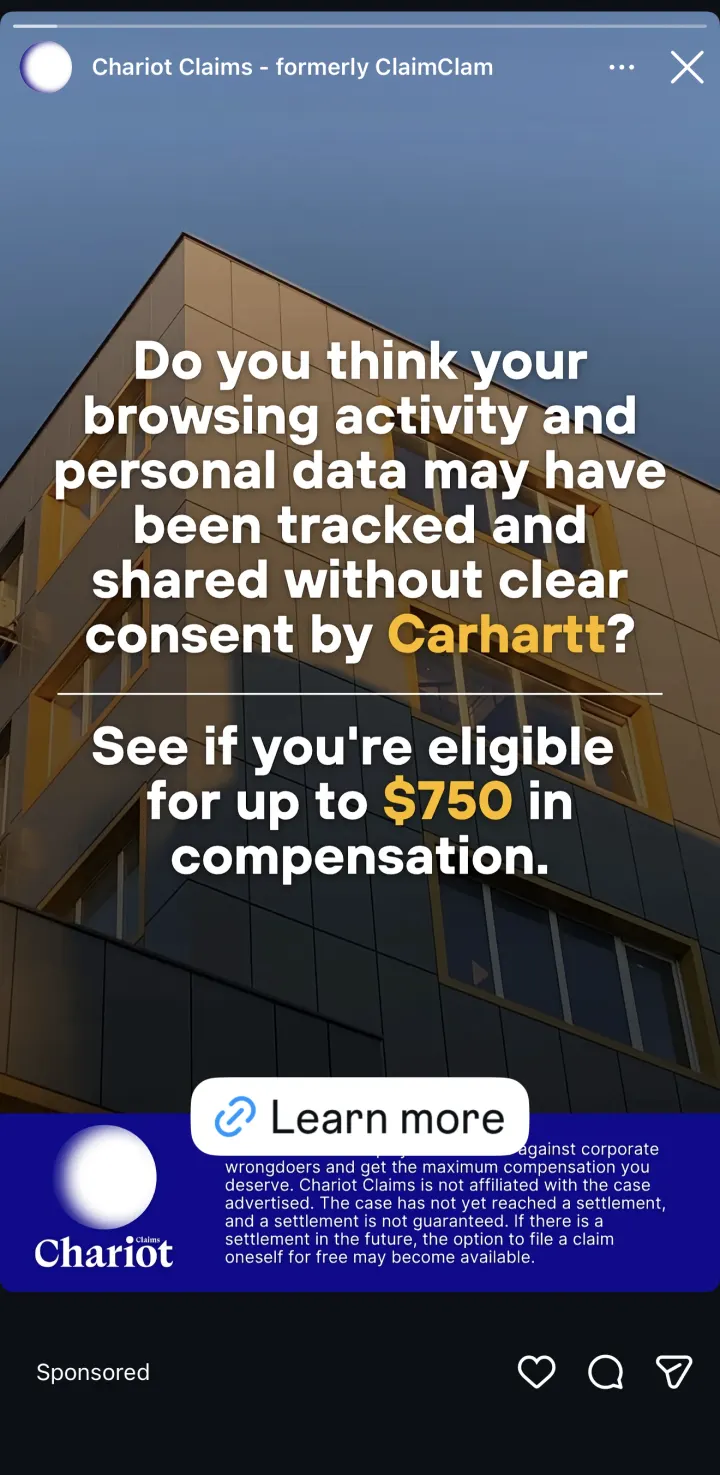
A Story ad: "Do you think your browsing activity and personal data may have been tracked and shared without clear consent by Carhartt?"
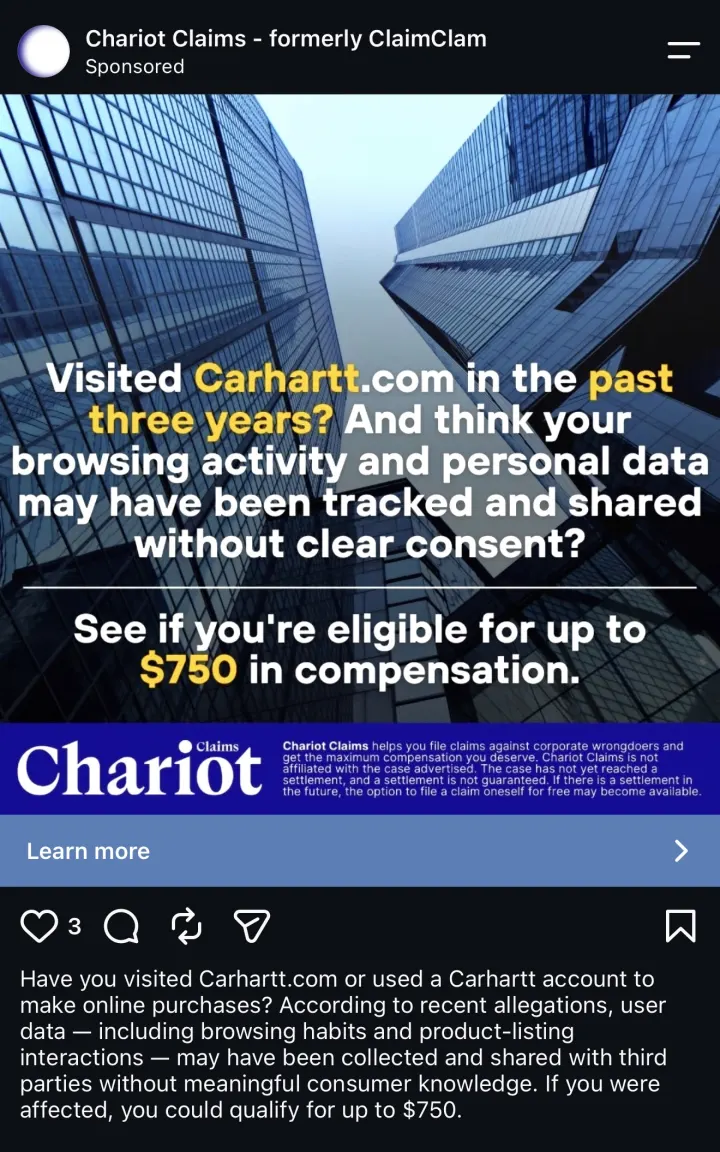
A feed ad with the same offer. The caption says browsing habits and product-listing interactions may have been shared with third parties.
Both ads run under the name "Chariot Claims - formerly ClaimClam." Both put the brand name in yellow and promise eligibility for "up to $750." The feed ad's caption describes the theory: according to "recent allegations," Carhartt.com user data, "including browsing habits and product-listing interactions," may have been collected and shared with third parties without meaningful consumer knowledge.
The fine print is the most candid part. Chariot says it is "not affiliated with the case advertised," that the case "has not yet reached a settlement," and that a settlement "is not guaranteed."
Note what the ads are not about. Carhartt is separately facing a class action over a data breach↗ filed in September 2026 after a hacking group claimed to have stolen data on about 12.9 million people. These ads describe something different: ordinary website tracking. Consumers seeing both stories at once is part of what makes privacy ads like these effective.
Who's running them
Chariot Claims was founded in 2023 as ClaimClam and rebranded in 2025. In October 2026 it raised a $10 million Series A↗ and said it processes more than 200,000 pre-qualified consumer claims a month. Its model is to match consumers with mass arbitration and class action cases, pay the cost of acquiring claimants up front, organize the evidence, and pair claimants with plaintiffs' firms. Its homepage cites more than 20 law firm partners.
Chariot's public case directory↗ shows the scale. When we checked it in October 2026, it listed 137 claims, and more than 60 were privacy claims against consumer brands. The list included Columbia Sportswear, Foot Locker, Patagonia, Zappos, Target, Dick's Sporting Goods, and Ro. One NVIDIA listing is limited to people who "declined or disabled non-required cookies." The Carhartt listing itself offers up to $750 to people who visited Carhartt.com and created or used an account "in the past year." The ad says "the past three years." Ads and listings run by different teams don't always match.
Why a marketplace changes the math
A single law firm buying ads for one campaign has to decide whether each brand is worth it. A marketplace spreads the cost of building ads, landing pages, eligibility questionnaires, and claimant support across dozens of brands at once. Adding one more brand is cheap.
That matters most for brands with mandatory arbitration clauses. Each signed-up claimant can become a separate arbitration demand, and the business can owe filing fees on each one. A marketplace delivering hundreds of claimants against a single retailer creates settlement pressure that has little to do with the strength of the legal theory. Our post on CIPA arbitration covers why those fees, more than the merits, often drive the outcome.
For an ecommerce brand, the practical takeaway is that being well known is now a risk factor. Plaintiff marketplaces need a name customers will recognize in a two-second scroll. The theories behind them are the same ones that appear in demand letters: pixels and analytics that load before consent, and opt-outs that don't actually stop tracking.
What the business may be missing
We don't know what Carhartt.com runs, and the ads make no finding. The ad copy does show which sites these campaigns are looking for:
- "Browsing habits and product-listing interactions." Product-view and add-to-cart events sent to ad platforms and analytics vendors are the standard evidence in these cases.
- "Without clear consent." The question is whether those events fire before a visitor agrees, or after a visitor declines.
- "Created or used an account." Logged-in sessions tie tracking events to a known person, which helps a claimant prove they were affected.
Every large ecommerce site sends product-view events to someone. What protects a brand is controlling when they're sent and being able to prove it.
See your site the way a claims marketplace does
The free CIPA scan records every pixel and third-party script that fires on your site before a visitor consents.
Scan my site →How PieEye closes the gap
Tracking waits for consent. PieEye's Trap and Trace Shield holds third-party scripts until the visitor consents, so product-view and cart events don't reach ad platforms by default.
"Decline" means decline. PieEye's consent management ties each banner category to the scripts in it, so a visitor who rejects advertising cookies turns off the advertising tags. That's exactly what listings like NVIDIA's are testing.
An inventory before the ads run. The free CIPA scan and FSCA scan show which trackers fire before consent, the same starting point a marketplace or plaintiff's firm uses to decide which brands to advertise against.
Claims marketplaces are now funded, staffed, and running dozens of brand campaigns at once. The best way to stay out of one is to give them no claim to sell.
This post is for general information and is not legal advice. The ads and listings described here are claims recruitment materials, not findings of wrongdoing.